> For the complete documentation index, see [llms.txt](https://docs.akto.io/llms.txt). Markdown versions of documentation pages are available by appending `.md` to page URLs; this page is available as [Markdown](https://docs.akto.io/traffic-connector/aws-services/aws-api-gateway.md).
# Connect Akto with AWS API Gateway
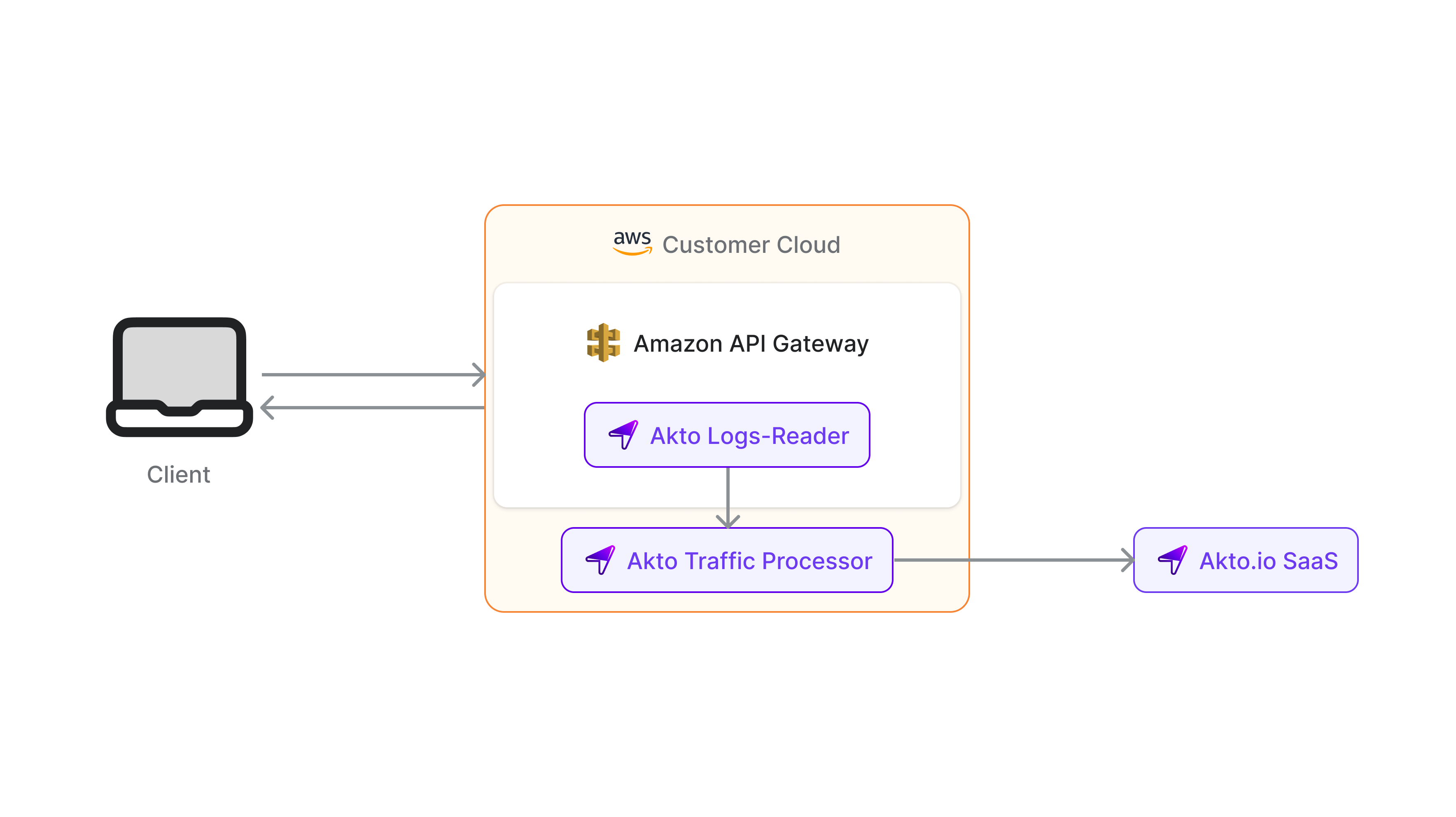
AWS API Gateway is a fully managed service from AWS that helps developers create, publish, monitor, and secure APIs at scale. By integrating AWS API Gateway with Akto, you'll automatically discover and test the security of all your REST APIs, HTTP APIs, and WebSocket APIs deployed through API Gateway, ensuring comprehensive API security across your AWS infrastructure.
To connect Akto with AWS API Gateway, follow these steps -
1. Set up and configure Akto Traffic Processor. The steps are mentioned [here](https://docs.akto.io/getting-started/traffic-processor/hybrid-saas).
2. Add AWS API Gateway connector
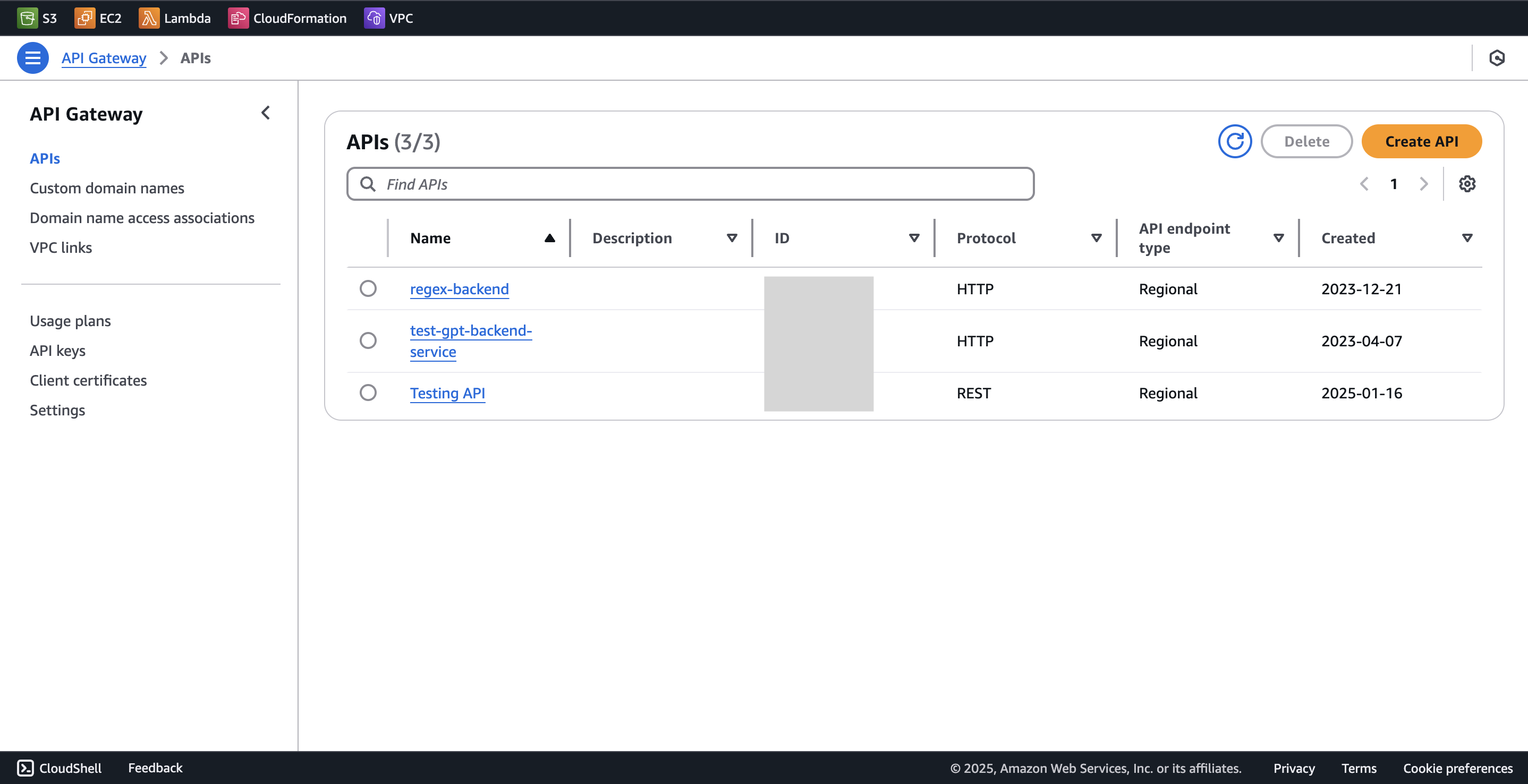
1. Go to **API gateway** in AWS console
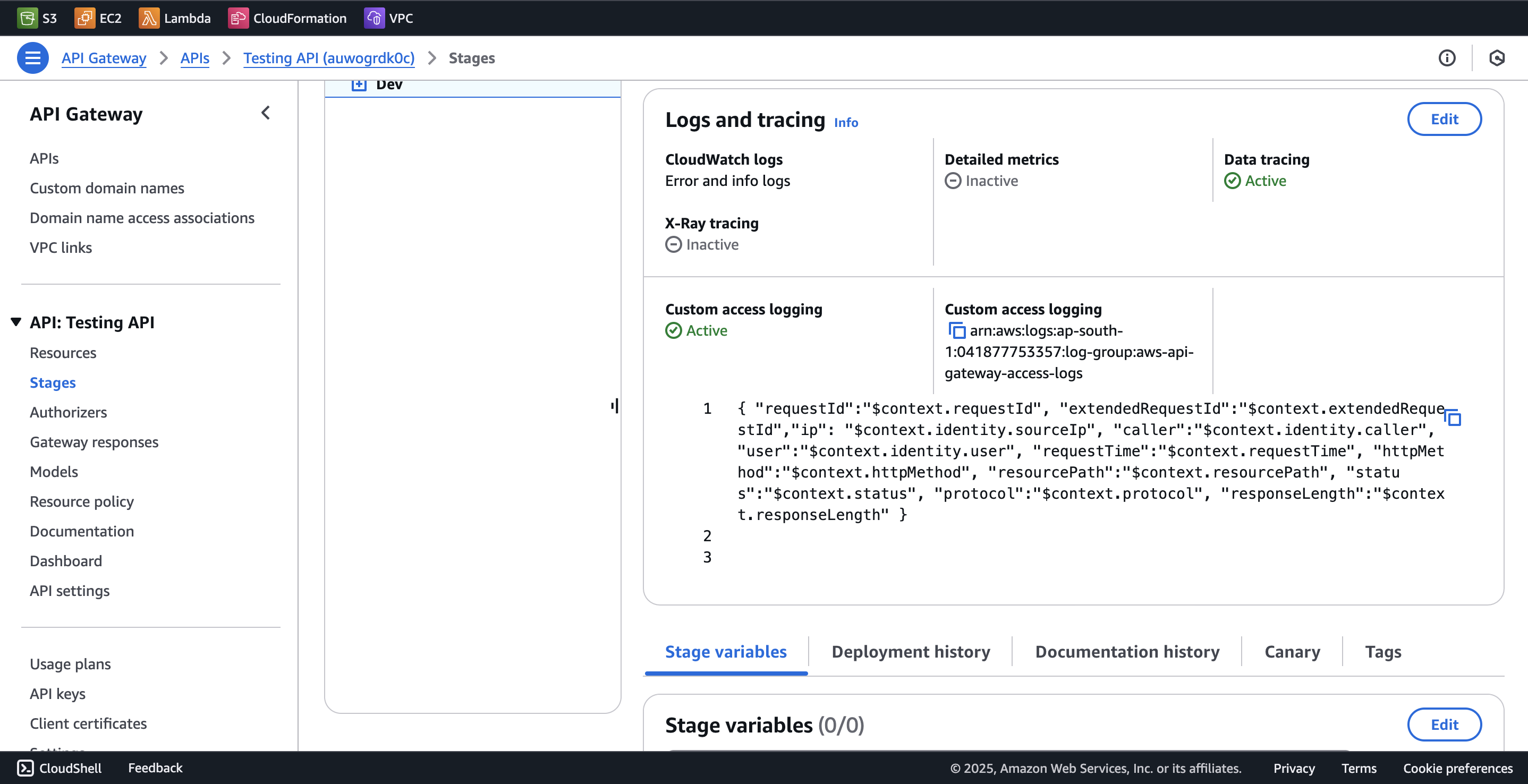
2. Go to your API, click on `Stages` from the left menu.
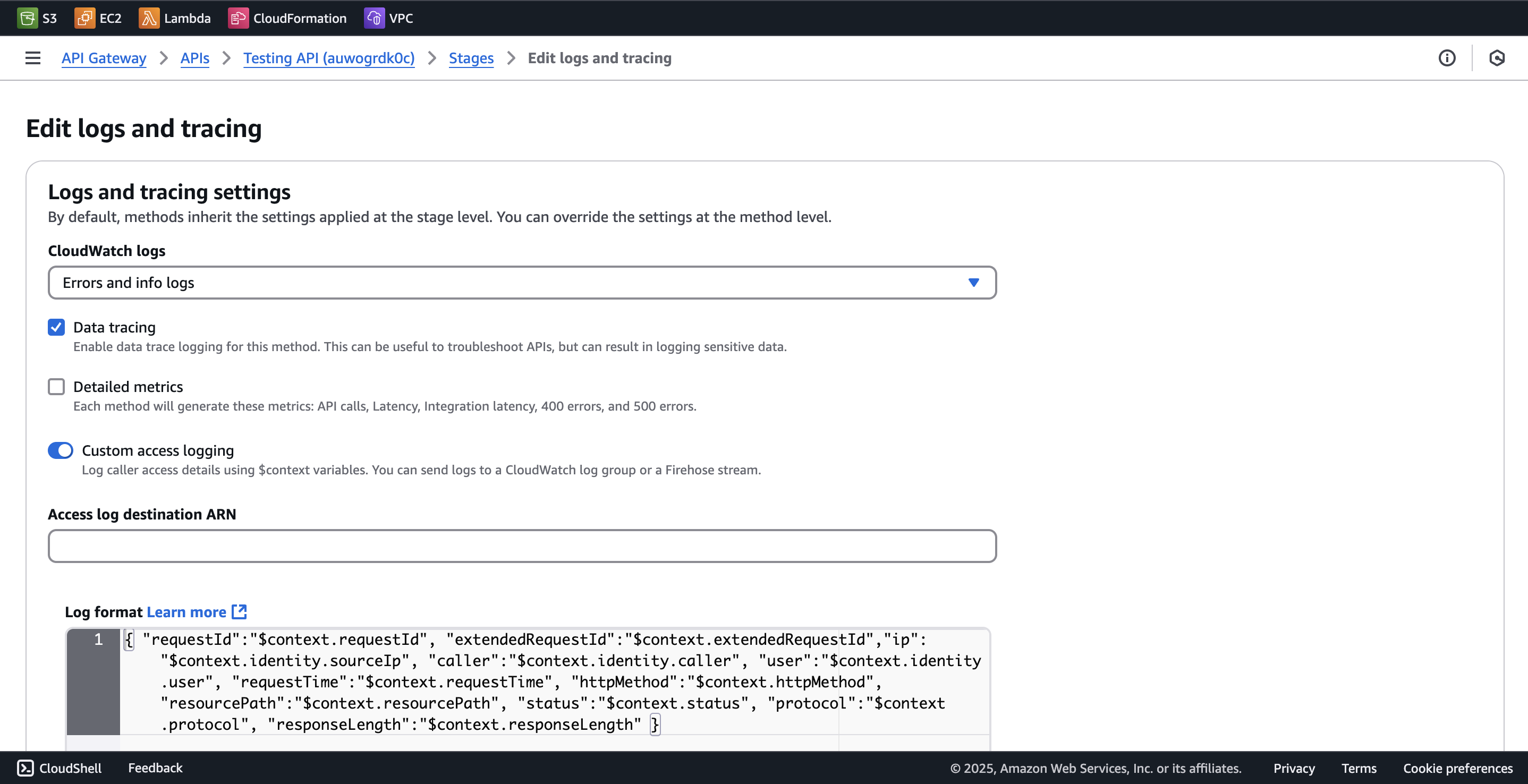
3. Scroll down to `Logs and tracing` section and click on `Edit`.
4. Select `Error and info logs` and `Data tracing` and save these settings.
```
{ "requestId":"$context.requestId", "extendedRequestId":"$context.extendedRequestId","ip": "$context.identity.sourceIp", "caller":"$context.identity.caller", "user":"$context.identity.user", "requestTime":"$context.requestTime", "httpMethod":"$context.httpMethod", "resourcePath":"$context.resourcePath", "status":"$context.status", "protocol":"$context.protocol", "responseLength":"$context.responseLength" }
```
5. Find out the `cloudwatch log group` for your API gateway for the stage which has the above logs enabled and save it. We'll need it later.
6. Deploy the connector (Kubernetes, Docker Compose, or CloudFormation).
1. For `LOG_GROUP_NAME`, use the CloudWatch log group name (from API Gateway Stage logs). You can use comma-separated (,) names to add multiple log group names.
2. For `AWS_REGION`, use the AWS region where that log group exists.
3. For `AKTO_KAFKA_BROKER_MAL`, use the Akto mini-runtime Kafka endpoint (`:9092`).
4. For Kubernetes and Docker Compose: For `AWS_ACCESS_KEY_ID`, `AWS_SECRET_ACCESS_KEY` and `AWS_SESSION_TOKEN`, use credentials that have permission to read the above CloudWatch log group. (CloudFormation uses IAM instance role—no credentials needed.)
5. For `DATABASE_ABSTRACTOR_TOKEN`, copy the token from Akto dashboard.
6. Use one of the deployment options below.
### Option A: Kubernetes deployment
```yaml
apiVersion: apps/v1
kind: Deployment
metadata:
name: api-gateway-logging
spec:
replicas: 1
selector:
matchLabels:
app: api-gateway-logging
template:
metadata:
labels:
app: api-gateway-logging
spec:
containers:
- image: aktosecurity/mirror-api-logging:api-gateway-logging-openapi
name: api-gateway-logging
imagePullPolicy: Always
resources: {}
env:
- name: AKTO_BYTES_IN_THRESHOLD
value: "100"
- name: AKTO_TRAFFIC_BATCH_TIME_SECS
value: "10"
- name: AKTO_TRAFFIC_BATCH_SIZE
value: "100"
- name: AKTO_KAFKA_BROKER_MAL
value: ""
- name: AWS_ACCESS_KEY_ID
value: ""
- name: AWS_SECRET_ACCESS_KEY
value: ""
- name: AWS_SESSION_TOKEN
value: ""
- name: CLOUDWATCH_READ_BATCH_SIZE
value: "5"
- name: LOG_GROUP_NAME
value: ""
- name: AWS_REGION
value: ""
- name: DATABASE_ABSTRACTOR_TOKEN
value: ""
- name: DISCOVER_OPENAPI_SPEC
value: "true"
- name: OPENAPI_DISCOVERY_INTERVAL_MINUTES
value: "15"
```
### Option B: Docker Compose
Create a `docker-compose.yml` and `watchtower.env` on your connector host:
*docker-compose.yml:*
```yaml
version: "3.9"
services:
api-gateway-logging:
image: aktosecurity/mirror-api-logging:api-gateway-logging-openapi
pull_policy: always
container_name: api-gateway-logging
restart: unless-stopped
environment:
AKTO_BYTES_IN_THRESHOLD: "100"
AKTO_TRAFFIC_BATCH_TIME_SECS: "10"
AKTO_TRAFFIC_BATCH_SIZE: "100"
AKTO_KAFKA_BROKER_MAL: ""
AWS_ACCESS_KEY_ID: ""
AWS_SECRET_ACCESS_KEY: ""
AWS_SESSION_TOKEN: ""
CLOUDWATCH_READ_BATCH_SIZE: "5"
LOG_GROUP_NAME: ""
AWS_REGION: ""
DATABASE_ABSTRACTOR_TOKEN: ""
DISCOVER_OPENAPI_SPEC: "true"
OPENAPI_DISCOVERY_INTERVAL_MINUTES: "15"
watchtower:
image: containrrr/watchtower
restart: always
volumes:
- /var/run/docker.sock:/var/run/docker.sock
env_file: ./watchtower.env
labels:
com.centurylinklabs.watchtower.enable: "false"
```
*watchtower.env:*
```bash
WATCHTOWER_CLEANUP=true
WATCHTOWER_POLL_INTERVAL=1800
```
Run:
```bash
docker compose up -d
docker compose logs -f --tail=200 api-gateway-logging
```
### Option C: CloudFormation (Automated deployment)
Download the CloudFormation scripts from the Akto infra repository:
* Repo path:
* Use folder: `api-gateway-connect-cloudformation`
Example:
```bash
git clone -b feature/quick-setup https://github.com/akto-api-security/infra.git
cd infra/api-gateway-connect-cloudformation
cp parameters.example.json parameters.json
```
Update `parameters.json` with your values, then deploy:
```bash
./deploy.sh akto-api-gateway-connector ap-south-1
```
This CloudFormation option creates the connector EC2 instance and runs the API Gateway connector automatically using Docker Compose.
## Environment variables reference
| Variable | What to set | Where to get it |
| ------------------------------------ | ----------------------------------------------------------------------------------------------------------- | ------------------------------------------------------------------------------------------------------------- |
| `AKTO_BYTES_IN_THRESHOLD` | Keep default (`100`) unless tuning needed | Akto connector runtime tuning value |
| `AKTO_TRAFFIC_BATCH_TIME_SECS` | Keep default (`10`) unless tuning needed | Akto connector runtime tuning value |
| `AKTO_TRAFFIC_BATCH_SIZE` | Keep default (`100`) unless tuning needed | Akto connector runtime tuning value |
| `AKTO_KAFKA_BROKER_MAL` | `:9092` | If mini-runtime is deployed using CloudFormation, go to stack **Outputs**, copy `AktoNLB`, and append `:9092` |
| `AWS_ACCESS_KEY_ID` | Access key ID (Kubernetes, Docker Compose only) | IAM user or temporary STS credentials with CloudWatch Logs read permissions |
| `AWS_SECRET_ACCESS_KEY` | Secret access key (Kubernetes, Docker Compose only) | IAM user or temporary STS credentials |
| `AWS_SESSION_TOKEN` | Session token if using temporary credentials (Kubernetes, Docker Compose only) | STS/assumed role session; leave empty for long-lived IAM user keys |
| `CLOUDWATCH_READ_BATCH_SIZE` | Keep default (`5`) unless tuning needed | Connector tuning value |
| `LOG_GROUP_NAME` | API Gateway execution/access log group name (Use comma-separated names to suppport more than one log group) | CloudWatch Logs console (for your API Gateway stage) |
| `AWS_REGION` | Region of API Gateway + CloudWatch log group | AWS region (example: `ap-south-1`) |
| `DATABASE_ABSTRACTOR_TOKEN` | Database abstractor token | Akto Dashboard > Quick Start > Hybrid SaaS > Runtime Service Command section |
| `DISCOVER_OPENAPI_SPEC` | `"true"` to enable OpenAPI discovery | Connector feature flag |
| `OPENAPI_DISCOVERY_INTERVAL_MINUTES` | Discovery interval (default `15`) | Connector tuning value |
Notes:
1. To create AWS CLI credentials, you can take reference from the [official AWS docs](https://docs.aws.amazon.com/sdkref/latest/guide/access-iam-users.html).
2. For AWS IAM policy permissions for cloudwatch, you can refer [here](https://docs.aws.amazon.com/apigateway/latest/developerguide/set-up-logging.html#apigateway-cloudwatch-log-formats).
## Get Support for your Akto setup
There are multiple ways to request support from Akto. We are 24X7 available on the following:
1. In-app `intercom` support. Message us with your query on intercom in Akto dashboard and someone will reply.
2. Join our [discord channel](https://www.akto.io/community) for community support.
3. Contact `help@akto.io` for email support.
4. Contact us [here](https://www.akto.io/contact-us).